
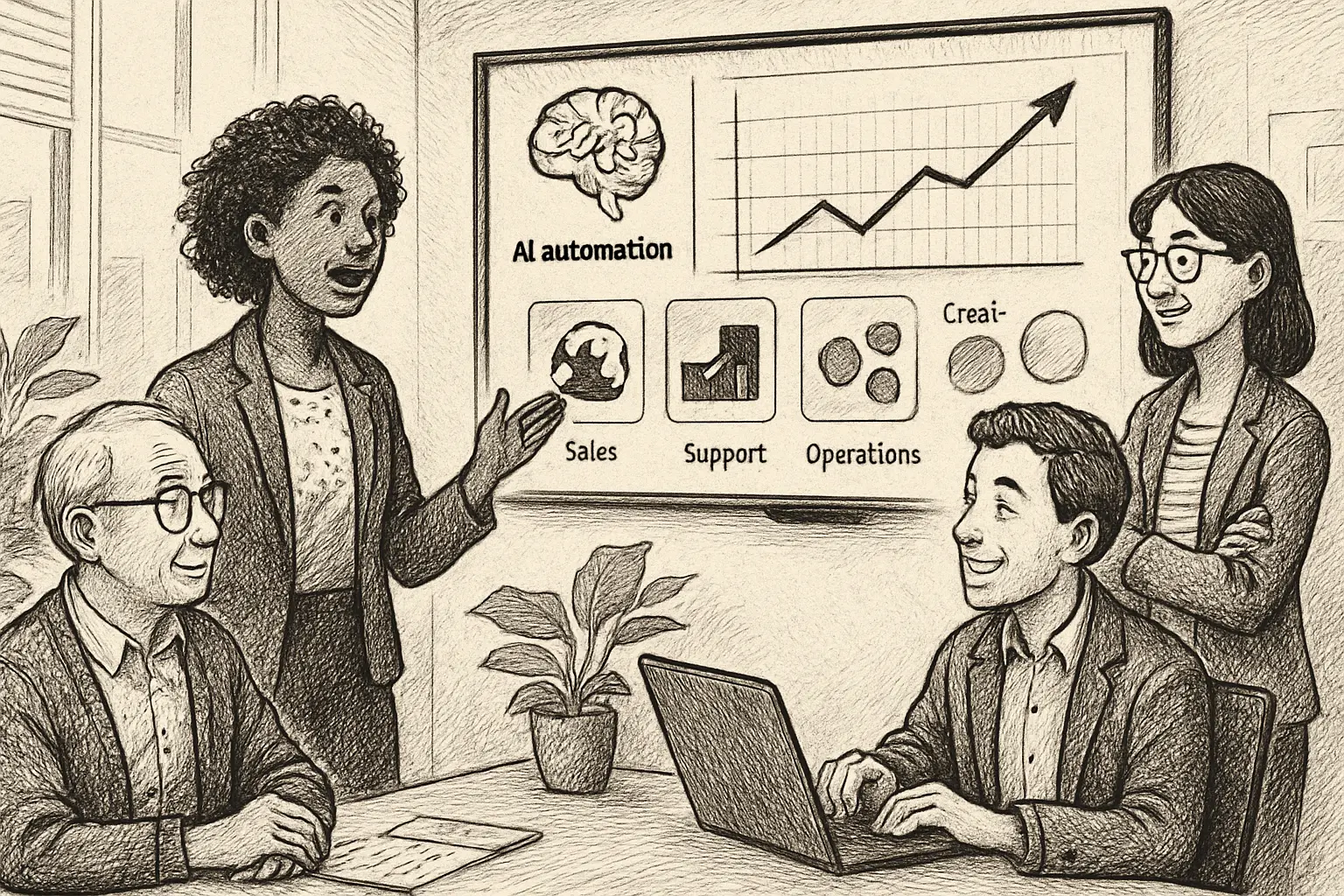
A concise playbook for agencies to package, price, and deliver AI automations at £5–£20k/month using agentic workflows, with clear ROI, pricing, and delivery guidance.
Why now is the moment
Marketing leaders want revenue impact without headcount. With 85% of enterprises using AI already and nearly 80% deploying agents, buyers are primed to purchase packaged automations instead of custom projects. The market is surging, budgets exist, and speed beats size.
A productized path to monthly revenue
Agencies can ship high-margin, recurring AI automations by packaging agentic workflows for sales, support, and ops. The AI agents market is projected to hit $103.6B by 2032 at 44.9% CAGR, signaling validated demand and long runway (S&S Insider via Plivo). Pair that with 43% of organizations directing over half of AI budgets to agentic AI and you have a strong budget capture story (Multimodal). Position your offering as a managed product, not a one-off project: fixed scope, fixed outcomes, and clear SLAs. Price in the £5–20k/month range anchored to the ROI expectation that 62% of organizations anticipate 100%+ returns from agents, averaging 171% globally and ~192% in the U.S. (PagerDuty/Wakefield via Multimodal). Remember, AI isn’t about replacing teams. It is about eliminating repetition, increasing throughput, and unlocking personalization at scale.
Small team, big outcomes.
Proving the upside with numbers that land
Tie pricing to a credible ROI story. Start with a simple equation: added revenue plus cost savings minus software and service fees. PwC estimates AI could add over $15T to the global economy by 2030, driven by efficiency and personalization gains. That macro signal helps frame AI as a growth lever, not a cost line. On the micro side, RPA delivers 30–200% ROI in year one; agentic AI typically exceeds this by handling complex workflows and decisions (Thunderbit). In sales, early deployments have boosted win rates by 30%+ through better lead scoring, outreach, and forecasting (Bain & Company via Cirrus Insight). Translate these stats into client-specific forecasts using their funnel math and cost base. If a sales AI package lifts conversion 10% and shortens cycles by 15%, the revenue delta often dwarfs a £10k/month subscription. Keep assumptions modest and time-bound, then validate monthly.
What happens under the hood
Agentic automations connect to CRMs, service desks, data warehouses, and communications channels. They observe events, reason over context, and act: drafting outreach, updating records, scheduling, routing tickets, or triggering workflows. Guardrails enforce permissions, logging, and human-in-the-loop escalation. Your product is the blueprint, integrations, prompts, and playbooks, plus monitoring and iteration.
Tradeoffs at a glance
| Advantage | Why it matters | Consideration | How to mitigate |
|---|---|---|---|
| Recurring revenue | Predictable £5–20k/month per client | Scope creep | Productize tight tiers and SLAs |
| Fast time to value | Deploy in weeks using existing tools | Data quality gaps | Add data readiness checklist and fixes |
| High ROI potential | 171% average ROI expected for agents | Outcome variance by client | Pilot with success metrics and gates |
| Budget tailwinds | 43% budgets for agentic AI | Vendor sprawl risk | Standardize stack and governance |
| Vertical expansion | Manufacturing, retail, healthcare ripe | Compliance complexity | Prebuilt controls and audit logging |
| Sales impact | 30%+ win rate gains reported | Change management | Train champions and phased rollout |
Spotlight on sectors leaning in
Manufacturing alone could gain $3.78T in value from AI by 2035 (Accenture). Pair quality checks, maintenance scheduling, and supplier coordination with agentic workflows to reduce downtime and waste. Retail and healthcare follow closely, where customer support deflection, inventory orchestration, and care navigation benefit from agents that can reason, plan, and act. With 66% of businesses already automating at least one process and that rising to 85% by 2029 (Thunderbit), packaged, vertical-specific automations command premium pricing because they solve familiar pains with proven playbooks.
Common questions, clear answers
How much can we charge without pushback? Anchor to outcomes. With many organizations expecting 100%+ ROI from agents, £5–20k/month is reasonable when you tie pricing to specific revenue lift or cost savings and include SLAs.
What tech stack do we need? Start with a reliable LLM, an orchestration layer for agent plans, native CRM and service desk connectors, event streaming, and observability. Keep it standard to speed delivery and support.
How long to first value? Most clients see measurable impact in 30 to 60 days. Lead scoring, pipeline hygiene, and support deflection ship fastest because data and workflows already exist.
Is this only for big enterprises? No. Mid-market firms are the sweet spot: they feel the pressure to scale, have budget, and value speed. With 85% of enterprises using AI in some function, even smaller teams expect partners to bring ready-made automations (Plivo roundup).
How do we avoid overpromising? Publish what the agent can and cannot do, require a pilot with success gates, keep humans in the loop for edge cases, and review metrics weekly for iteration.
Your next move
If you are ready to turn AI from experiments into a reliable revenue line, productize two to three agentic workflows that map to clear KPIs, pilot fast, and price on value. Then scale with playbooks. To see how this looks in practice, book a demo with Volume 11 of the software. We will walk you through packaged automations, pricing models, and delivery kits you can deploy this quarter.
Helpful comparisons
| Area | Starter Package | Growth Package | Enterprise Package |
|---|---|---|---|
| Monthly fee | £5k | £10k | £20k |
| Workflows | 2 | 5 | 8 |
| Channels | Email, CRM | Email, CRM, Chat | Omnichannel |
| Guardrails | Basic | Advanced | Advanced + Audit |
| Support | Business hours | 24x5 | 24x7 + SLOs |
Quick validation checklist
- Identify a revenue-critical workflow with clear KPIs.
- Confirm data readiness and integration access.
- Define success metrics and a 30-day pilot scope.
- Implement guardrails and human review paths.
- Instrument dashboards for daily outcomes tracking.
Sources: Plivo (AI agents and enterprise adoption); Multimodal (agentic AI ROI and budgets); PwC via Exploding Topics (macro value); Accenture via Exploding Topics (industry gains); Thunderbit (automation and RPA ROI); Bain & Company via Cirrus Insight (sales impact).