
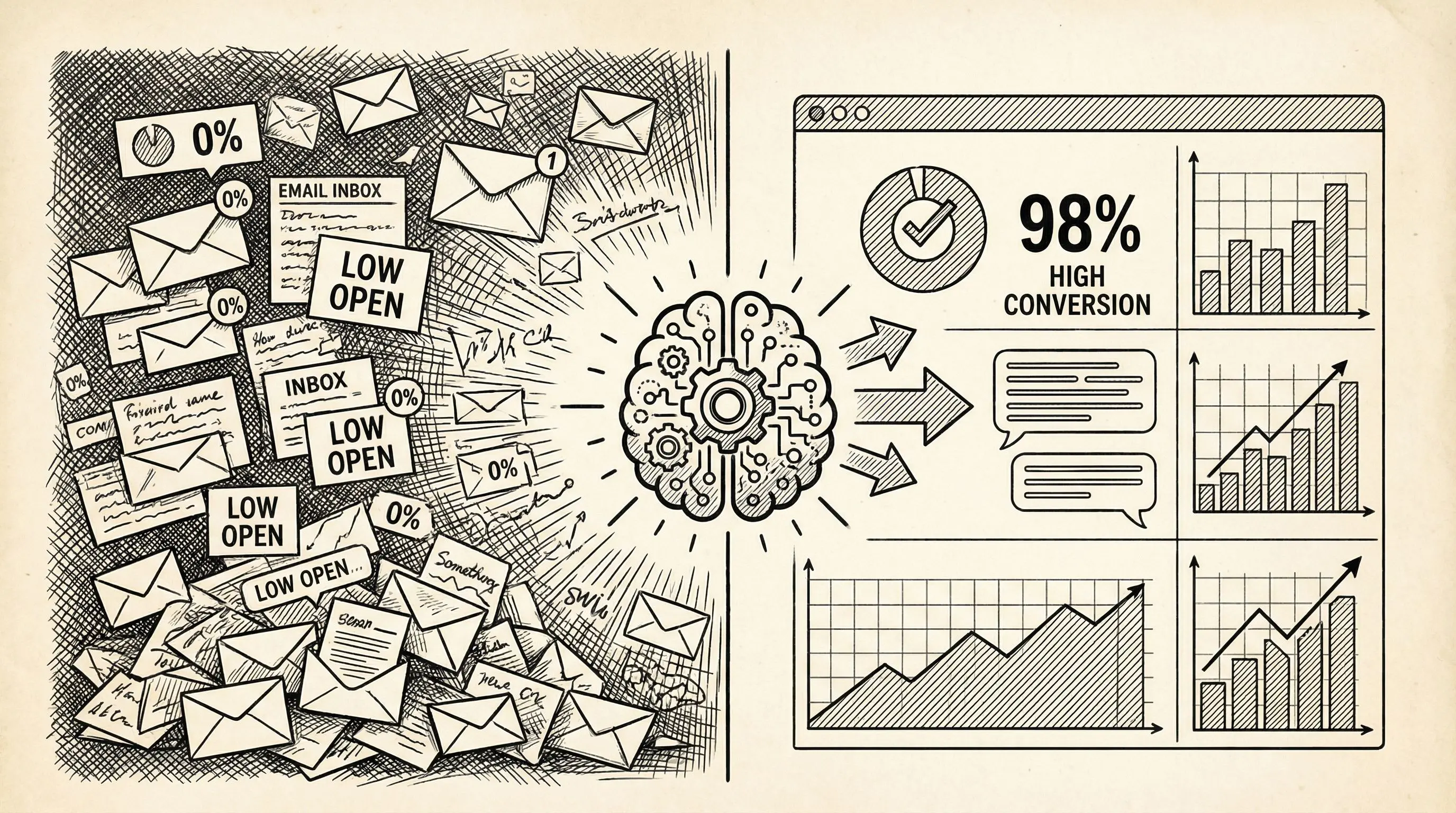
SMS outperforms email on speed, engagement, and conversions. Here is how AI leaders pair SMS and email to maximize real-time revenue and build long-term relationships without annoying customers.
Your AI Is Only As Strong As Its Channel
AI can predict the perfect moment to engage, but if your message sits in an inbox, the moment is gone. With email’s slower opens and lower clicks, real-time triggers underperform. SMS puts your AI on a channel that is actually seen and acted on.
A Channel Strategy That Actually Moves
If your goal is speed and action, SMS should be your default for AI-triggered outreach. SMS reaches roughly 98% of recipients with most opens in minutes, while email averages 20-45% and often waits hours or days to be seen (Moosend). For performance, SMS click-through rates average around 36% compared to email’s 2-4% - even conservative SMS ranges of 10-20% still win handily (EngageBay). Conversion rates tell the same story: SMS drives 21-30% across industries, up to 40% in tech, versus roughly 15% for email (Moosend).
Use SMS for flash sales, cart recovery, appointment reminders, shipping alerts, and any real-time journey steps where timing is everything. Consumers expect transactional messages in under five minutes - SMS is the only channel that reliably delivers at that speed and visibility (Sinch). Keep email for storytelling, education, and depth. The winning move is not SMS or email - it is SMS for action and email for nurture, orchestrated by AI across the journey (Bloomreach, Vonage).
Proving It On The Dashboard
Measure SMS like a revenue channel, not a vanity metric. Start with delivery rate and time to open to confirm you are meeting the under-five-minute expectation for transactional messages (Sinch). Then track CTR and response rate to quantify engagement. SMS delivers average response rates near 45% versus 6% for email, with 90% of replies within 30 minutes - perfect for AI-driven two-way flows like confirmations, surveys, and service (Kixie).
Tie engagement to outcomes: conversion rate, revenue per message, and customer lifetime value. For AI-triggered moments like cart recovery, compare SMS-first paths against email-first paths to see the lift in orders and speed to purchase. Finally, monitor opt-out rate, complaint rate, and frequency caps. High personalization and clear value are non-negotiable - AI’s segmentation and timing models keep SMS helpful, not intrusive (Moosend).
From Trigger To Tap
Your AI identifies an intent signal - price sensitivity, abandoned cart, or nearing appointment. A decision engine selects SMS or email based on urgency and predicted action. SMS templates pull in dynamic fields and short links. The message sends within seconds, opens in minutes, and responses route to automated or human follow-up. Email follows with depth for those who need more context.
Strengths vs. Watchouts
| What to know | Pros | Considerations |
|---|---|---|
| Visibility and speed | ~98% opens and minutes-to-read drive instant reach (Moosend) | Over-messaging erodes trust - enforce frequency caps |
| Clicks and conversions | 18-36% CTR and 21-30% conversion lift performance (EngageBay, Moosend, Vonage) | Short format limits storytelling - pair with email |
| Real-time interactions | 45% response rates - 90% of replies inside 30 minutes (Kixie) | Requires staffing or bots for two-way flows |
| Compliance and consent | Rising opt-ins - 84% say yes to business texts (Mailmodo) | Must manage opt-ins, opt-outs, and regional regulations |
| Omnichannel orchestration | SMS is the engine - email reinforces and educates (Bloomreach) | Poor routing can create duplication or fatigue |
Industry Callout: Where The Gains Are Fastest
Retail and ecommerce see immediate wins by pairing AI intent scoring with SMS for cart recovery, back-in-stock, and limited-time drops. Appointment-heavy sectors like healthcare and services reduce no-shows with timely reminders and confirmations. SaaS and tech teams boost trial-to-paid with usage-triggered nudges that land instantly. In every case, email is the follow-up channel for education and onboarding. Treat SMS as the engine for action, and email as the layer that deepens understanding and brand equity. That balance delivers both short-term revenue and long-term loyalty.
Quick FAQs
How do I avoid SMS fatigue? Keep messages short, valuable, and personalized, and set frequency caps by segment and lifecycle stage. AI helps throttle timing based on predicted utility.
What should I send over SMS versus email? Use SMS for urgent, transactional, and high-intent moments like recoveries, reminders, and alerts. Use email for storytelling, onboarding, and detailed education.
Do I need two-way SMS? For support, confirmations, and surveys, yes. SMS’s 45% response rate makes two-way threads highly effective. Route replies to intelligent bots or agents with clear escalation.
Will SMS work for B2B? Absolutely. Decision makers read texts faster than email, especially for confirmations, reminders, and product usage alerts. Keep tone professional, opt-in compliant, and value clear.
How do I measure success? Track delivery, time-to-open, CTR, response rate, conversion, revenue per message, and opt-out rate. Compare SMS-first versus email-first paths across key journeys.
Make It Happen
Ready to see AI plus SMS drive measurable revenue, faster? Book a demo with Volume 11 of the software. We will map your key journeys, set up compliant opt-ins, build AI triggers, and orchestrate SMS with email so you get instant action and long-term loyalty.